Posted by:

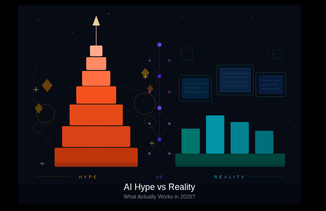
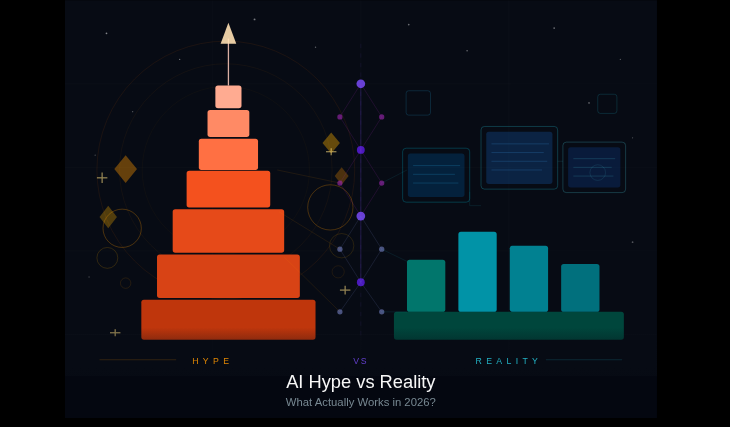
AI Hype vs Reality: What Actually Works in 2026?
clear-eyed scorecard of what AI does in 2026 — coding, content, design — and where the hype collapsed: autonomous agents, AGI timelines, full-job automation.
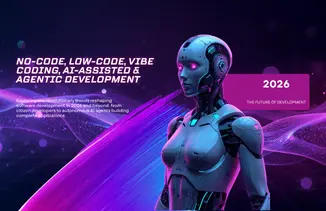
In 2018, the question was simple: can your company afford to hire developers? In 2026, the question is more complex: which of five fundamentally different development approaches is right for what you are building, for who is building it, and for the risk level you can accept? The answer is no longer obvious, and the stakes are high either way.
A marketing manager who does not know about WebFlow is spending company money on developers for tasks that take eight minutes in a visual editor. A startup founder who does not know about Lovable is spending eight months building what 25% of Y Combinator Winter 2025 startups built in weeks using AI-generated codebases. A professional developer who does not know about Claude Code or GitHub Copilot is working at roughly half the speed of peers who do. And an enterprise CTO who does not understand the difference between vibe coding and agentic engineering is making deployment decisions with incomplete information.
This guide covers all five approaches in detail: what each one is, who it is for, what it costs, what it cannot do, which tools to use, and the practical decision framework for choosing the right approach for your specific situation.
THE STATE OF SOFTWARE DEVELOPMENT IN 2026 — KEY DATA
Definitions: What Each Approach Actually Means
1. No-Code Development
No-code means building software using purely visual, drag-and-drop interfaces with zero lines of code written by the user. The platform handles all the underlying logic, hosting, security, and infrastructure. The builder’s job is to configure and connect — not to write. Examples: Webflow for websites, Bubble for web apps, Zapier for automations, Airtable for data tools. The target user is a business professional who has never written code and has no intention of starting.
2. Low-Code Development
Low-code is primarily visual development with optional code for complex requirements. A low-code platform provides pre-built components, templates, and connectors that developers or technically literate business users assemble visually — then extend with custom code when the platform limits are reached. Examples: Retool for internal tools, OutSystems for enterprise applications, Microsoft Power Apps for Office-connected workflows. Low-code typically produces more scalable, integration-rich output than no-code, at the cost of requiring some technical skill.
3. Vibe Coding
Vibe coding is a term coined by AI researcher Andrej Karpathy in February 2025 and named Collins Dictionary’s Word of the Year for 2025. It describes building software by describing what you want in plain English and letting an AI generate all the code. The critical distinction is that the user may not read, understand, or fully review the generated code — they iterate through prompts rather than through traditional coding. In Karpathy’s original framing: ‘You fully give in to the vibes, embrace exponentials, and forget that the code even exists.’ By February 2026, Karpathy himself declared the term ‘passé’ — the concept had matured into the more structured paradigm of agentic engineering.
4. AI-Assisted Development
AI-assisted development is the professional, disciplined application of AI tools within traditional software engineering. The developer remains in control: they still write, review, and understand the code. AI tools — GitHub Copilot, Claude Code, Gemini Code Assist — act as intelligent pair programmers that suggest completions, generate boilerplate, explain complex code, identify bugs, and accelerate repetitive tasks. Unlike vibe coding, the developer reads every line of AI-generated code before accepting it. This is the approach that 92% of professional developers now use daily in some form.
5. Agentic Development
Agentic development is AI-powered engineering where autonomous agents plan, write, test, debug, and deploy code across multiple files and systems with minimal human intervention per task. The human sets the goal and approves the output at defined review gates; the agent handles all implementation steps in between. Tools like Claude Code in agentic mode, Devin (Cognition AI), and Replit Agent represent this category. Karpathy’s updated preferred term for this professional paradigm is ‘agentic engineering’: the developer is not writing code 99% of the time but is orchestrating AI agents and applying engineering judgment to their direction. This is where the field is heading.
Full Comparison: All Five Approaches Across Every Dimension
When to Use Which Approach: Practical Decision Framework
The most common mistake is choosing an approach based on what is exciting rather than what is appropriate. Vibe coding is not better than no-code just because it is newer. No-code is not inferior to AI-assisted development just because it requires less skill. Each approach has a specific performance profile. Match the approach to the job.
The Future of Software Development: Where Each Approach Is Heading
No-Code — Trajectory: Mainstream for business users
No-code is becoming the default tool for business operations, marketing, and HR teams. 80% of technology products will be built by non-developers by 2026 according to Gartner. The platforms are adding AI features that make them even more powerful — WebFlow AI site builder, Zapier’s AI automation builder, and Airtable’s AI field generation are all pushing the complexity ceiling upward without requiring more skill from the user.
Low-Code — Trajectory: Enterprise standard for business application development
The $101.7 billion market projection for 2030 reflects the sustained confidence in low-code as the enterprise application development standard. By 2029, Gartner projects low-code platforms will power 80% of mission-critical enterprise applications globally. The addition of AI to low-code platforms — AI-generated UI, intelligent data mapping, automated testing — is compressing development time further without removing the engineering rigour that enterprise requirements demand.
Vibe Coding — Trajectory: Prototype and MVP standard, evolving into agentic engineering
Vibe coding in its pure form — describe it, accept it, iterate without reviewing — is already being superseded by the more structured agentic engineering paradigm. The vibe coding market is projected to reach $8.5 billion by 2026 and $325 billion by 2040. But the form factor is changing: tools are adding review gates, security scanning, and code quality checks that push the practice toward responsible AI-assisted development. The line between vibe coding, AI-assisted development, and agentic development is blurring by design.
AI-Assisted Development — Trajectory: The new baseline for professional engineering
AI-assisted development is not a trend. It is the new default. 92% of US developers already use AI tools daily. The question is no longer ‘should I use AI to write code?’ but ‘how do I use AI to write better code faster?’ The tools are becoming more capable, more context-aware, and more integrated into existing workflows. GitHub Copilot, Claude Code, and Gemini Code Assist are not novelties — they are professional infrastructure.
Agentic Development — Trajectory: The frontier of software engineering
Agentic development is where the field is heading. Karpathy’s ‘agentic engineering’ paradigm — where the developer orchestrates AI agents rather than writing code directly — is already being practised at the frontier of AI-native companies. 40% of enterprise applications in 2026 incorporate AI agents. The challenge is governance: defining clear review gates, security boundaries, and oversight protocols that allow agentic tools to deliver their speed advantage without the production risks documented in 2025.
Frequently Asked Questions
Q1: What is vibe coding and is it real or just a buzzword?
Vibe coding is real and consequential. It was coined by Andrej Karpathy in February 2025, named Collins Dictionary’s Word of the Year for 2025, and is now used in some form by 92% of US developers. It describes building software by describing what you want in natural language and accepting AI-generated code without necessarily reading every line. It is particularly impactful for prototypes and MVPs: 25% of Y Combinator’s Winter 2025 startup cohort had codebases that were 95% AI-generated. However, for production software, the risks are documented: AI-generated code has 1.7x more major issues than human-written code, security vulnerabilities are 2.74x higher, and 10% of apps built on one popular vibe coding platform had exposed user data.
Q2: What is the difference between vibe coding and AI-assisted development?
The key distinction is review and understanding. In AI-assisted development, the developer reads, reviews, tests, and understands every line of AI-generated code before accepting it. AI is a tool; the developer is still the engineer. In vibe coding, the user may not read the code at all — they iterate through prompts, testing whether the output works rather than understanding how it works. AI-assisted development maintains engineering rigour. Vibe coding prioritises speed. For prototypes and MVPs, vibe coding is often the right choice. For production systems, AI-assisted development is the responsible standard.
Q3: What is the difference between low-code and no-code?
No-code requires absolutely zero programming knowledge. The entire experience is visual: drag, drop, configure. Examples include Webflow, Bubble, and Zapier. Low-code platforms also have a visual development layer, but they allow and sometimes require custom code for complex requirements. Low-code typically produces more scalable, integration-rich output and targets technically literate business users or junior developers. No-code targets non-technical users entirely. In practice, the boundary is blurring as no-code platforms add more capability and low-code platforms simplify their interfaces.
Q4: What is agentic development and how is it different from vibe coding?
Vibe coding involves describing what you want and accepting AI-generated output, often without full review. Agentic development is more structured: AI agents plan, implement, test, and iterate across an entire system autonomously, while the human provides architectural direction and reviews output at defined gates. Agentic development is the professional evolution of vibe coding. Karpathy himself described his preferred updated paradigm as ‘agentic engineering’: the developer is not writing code 99% of the time but is orchestrating AI agents, applying engineering judgment to direction rather than implementation. The tools include Claude Code in agentic mode, Devin, and Replit Agent.
Q5: Which approach is best for a startup with no technical co-founder?
For an early-stage startup with no technical co-founder, the recommended path in 2026 is: (1) Start with no-code or vibe coding for the initial MVP. Tools like Bubble, Webflow, or Lovable allow a non-technical founder to build a functional, testable product in days rather than months. (2) Use the MVP to validate the concept with real users. (3) Once product-market fit is established, raise funding or hire an engineer to rebuild critical components with proper engineering rigour. 25% of Y Combinator Winter 2025 startups had 95%+ AI-generated codebases — the approach is validated at the highest level of startup validation available.
Q6: What are the biggest risks of vibe coding and agentic development?
Four documented risks. First, security vulnerabilities: AI-generated code has security vulnerabilities 2.74x more common than human-written code, and 10% of apps on one major vibe coding platform had exposed user data. Second, technical debt: code that no human understands is code that cannot be maintained or debugged effectively. Third, unpredictable agent behaviour: a Replit AI agent deleted a production database in July 2025 despite explicit instructions not to touch production. Fourth, false confidence: experienced developers predicted they would be 24% faster using AI tools and believed afterward they had been 20% faster. The controlled study found they were 19% slower. The antidote is structured review gates, security scanning, and maintaining the principle that no AI-generated code goes to production without human review.
Q7: What tools should a business start with in each category?
No-code: Webflow for websites, Bubble for web apps, Zapier for automations, Airtable for database tools. Low-code: Retool for internal dashboards, OutSystems or Mendix for enterprise applications, Microsoft Power Apps if your team is in the Microsoft ecosystem. Vibe coding: Lovable or Bolt.new for non-developers building web apps from descriptions, Cursor or Windsurf for developers who want an AI-native IDE. AI-assisted: GitHub Copilot for teams using GitHub, Claude Code for large codebase work and terminal-based development, Gemini Code Assist if your team is in the Google ecosystem. Agentic: Claude Code agentic mode for experienced engineers, Devin for fully autonomous feature development, LangChain or CrewAI for building multi-agent systems.
Q8: Will traditional software development become obsolete?
No — not in the foreseeable future, and not for the use cases that matter most. Traditional engineering with AI assistance is becoming the new baseline, not the old paradigm being replaced. Complex systems, enterprise infrastructure, regulated applications, real-time systems, security-critical software, and anything where reliability and maintainability are mission-critical will continue to require deliberate human engineering. What is changing is the tool stack: developers who use AI-assisted development produce more, maintain less friction, and deliver faster. The human engineering judgment applied to architecture, security, system design, and code review is not being replaced. It is being amplified.
Latest insights